
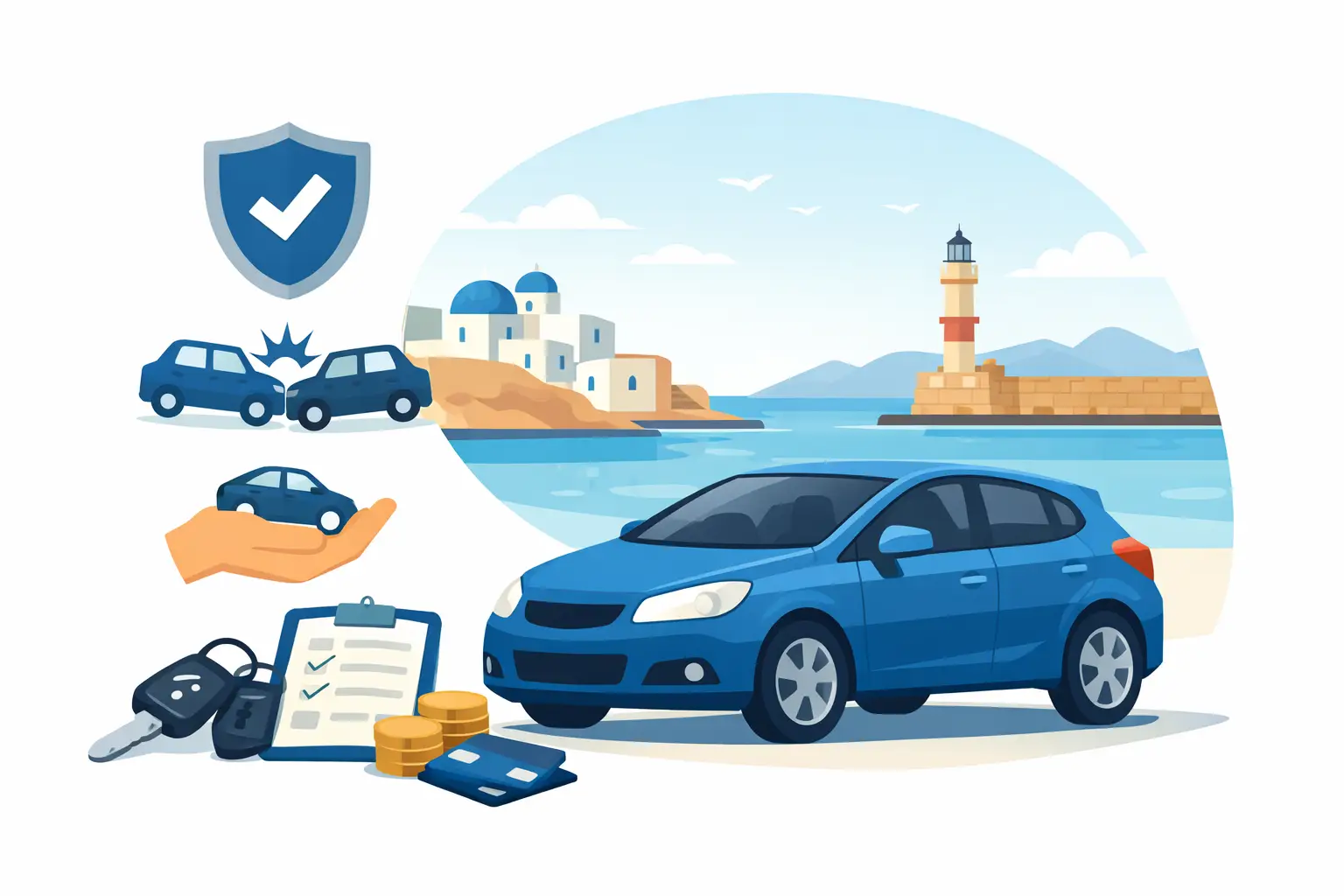
A low headline price can look like a bargain until the desk asks you to accept a large excess, pay for extra protection, or leave a substantial card deposit. That is why asking what is included in car hire insurance before you book matters just as much as choosing the right size car for your holiday in Crete.
The short answer is that car hire insurance often includes basic third-party liability and some damage cover, but the level of protection varies greatly between rental companies. The details determine what you could pay if the car is damaged, stolen, or affected by something as ordinary as a chipped windscreen in a car park.
What is included in car hire insurance?
Most car hire bookings include a combination of legally required cover and protection arranged by the rental company. The names can differ, and terms such as “full insurance” are not always as clear as they sound. Read the inclusions alongside the excess, exclusions and payment conditions.
Third-party liability cover
Third-party liability insurance covers injury or damage you cause to other people, vehicles or property while driving the hire car. It is a core requirement for a road-legal rental vehicle and is normally included in the quoted rental price.
This cover does not usually pay for damage to the hire car itself. If you scrape a wall while parking in a Cretan village, third-party cover may deal with damage to somebody else’s property, but the cost of repairing the rental car is dealt with under a different part of the policy.
Collision damage waiver
Collision Damage Waiver, usually called CDW, reduces your financial responsibility if the hire car is damaged in an accident. It is not always conventional insurance in the strict sense. It is a waiver from the rental company that limits what they can charge you, provided you follow the rental agreement.
The key question is not simply whether CDW is included. Ask whether it comes with an excess. An excess is the maximum amount you may have to pay towards damage. A booking can advertise CDW as included while still leaving you responsible for €800, €1,200 or more. This is one reason customers can face an unexpected deposit or a pressure sell for additional cover at collection.
CDW with no excess means you should not be charged an excess for covered accidental damage. That is clearer and more reassuring, particularly when you are driving on unfamiliar roads after a flight.
Theft protection and fire cover
Theft protection limits your responsibility if the vehicle is stolen, while fire cover applies if it is damaged by fire. As with CDW, these protections can carry an excess unless the terms specifically state otherwise.
Check whether theft and fire cover have no excess, not just collision damage. The wording matters. A policy that removes the excess for one type of claim may still leave an excess for another.
Tyres, glass and mirrors
Tyres, windscreens, side windows, wheels, underbody damage and mirrors are frequently excluded from standard CDW. Yet these are among the parts most likely to be damaged during a holiday, whether by a loose stone on a rural road, a tight parking space, or a kerb you did not spot while manoeuvring.
For visitors to Crete, glass and tyre cover is particularly useful. Roads to beaches, mountain villages and quieter parts of the island can vary in width and surface. That does not mean you should take a rental car onto unsuitable tracks, but it does mean the small-print exclusions deserve proper attention.
At ORION Rent A Car, the quoted comprehensive cover is designed to be straightforward: CDW with no excess, theft and fire cover with no excess, plus cover for tyres, glass and mirrors. Knowing this before arrival helps guests avoid the usual counter discussion about costly upgrades.
What car hire insurance may not include
Even comprehensive cover has conditions. Clear rental terms protect both the customer and the rental company, and they make it easier to know where you stand if something happens.
Insurance generally will not cover damage or loss caused by driving under the influence of alcohol or drugs, reckless driving, or allowing an unauthorised person to drive. It may also exclude damage where the wrong fuel has been used, keys are lost, or the vehicle has been driven on roads or terrain prohibited by the agreement.
Off-road driving is a common point of confusion in Crete. A scenic route is not automatically off-road, but unpaved tracks, beaches, riverbeds and rough roads not suitable for the vehicle can fall outside the cover. If you are planning to visit remote areas, ask what is permitted for your chosen car rather than assuming every route is covered.
Personal belongings are another separate issue. Car hire insurance is usually about the vehicle and third-party liability, not luggage, phones, cameras or other items left in the car. Your travel insurance may provide some protection for possessions, subject to its own terms. Never leave valuables visible, even for a short stop.
Excess, deposits and credit cards: understand the difference
An excess is not always the same as a deposit. The excess is the amount you could owe following a covered damage or theft claim. A deposit, meanwhile, is money held or pre-authorised by the rental company as security during the hire.
A company may offer low daily rental prices but require a large credit-card hold because the booking has a high excess. This can be inconvenient for families managing holiday spending, and it can be especially frustrating when the requirement only becomes obvious at the desk.
No-excess cover removes a major area of uncertainty, but still check the collection terms. Ask whether a credit card is required, whether any security amount is blocked, and which payment methods are accepted. Transparent answers are more valuable than vague labels such as “premium protection” or “super cover”.
How to compare car hire insurance properly
When comparing two prices, put the insurance details beside the final total. The cheaper option is not necessarily cheaper once excess reduction, tyre cover, additional drivers, mileage, airport collection costs and taxes have been added.
Before reserving, check these practical points:
- Is CDW included, and does it have an excess?
- Are theft and fire covered, and is their excess also zero?
- Are tyres, glass, mirrors, wheels and the underbody included or excluded?
- Does the quote include VAT, unlimited or free mileage, and any delivery or airport charges?
- Is a credit card, deposit or pre-authorisation required at collection?
- Who can drive the car, and what should you do if there is an accident or damage?
It is also sensible to keep a copy of the rental agreement on your phone and take a few photographs of the car when you collect it. A good rental company will already record the vehicle condition clearly, but a quick set of time-stamped photos gives you added peace of mind.
If something happens during your hire
A scratch, puncture or accident is stressful enough without trying to decode policy wording. Contact the rental company as soon as it is safe to do so, follow their instructions, and obtain police documentation if required. Do not arrange repairs independently unless the company has authorised this.
For an accident involving another vehicle or person, exchange the relevant details, take photographs where safe, and avoid admitting liability at the roadside. If the car cannot be driven, use the assistance number supplied with your rental documents. A provider offering 24-hour assistance across Crete can make a difficult moment much more manageable.
The best car hire insurance is not simply the policy with the longest description. It is cover written in plain terms, with no surprise excess, no hidden costs, and a real person ready to help if your plans change or the unexpected happens.
 Complete Insurance
 Free km (mileage)
 VAT – Inclusive price
Leave a Reply