
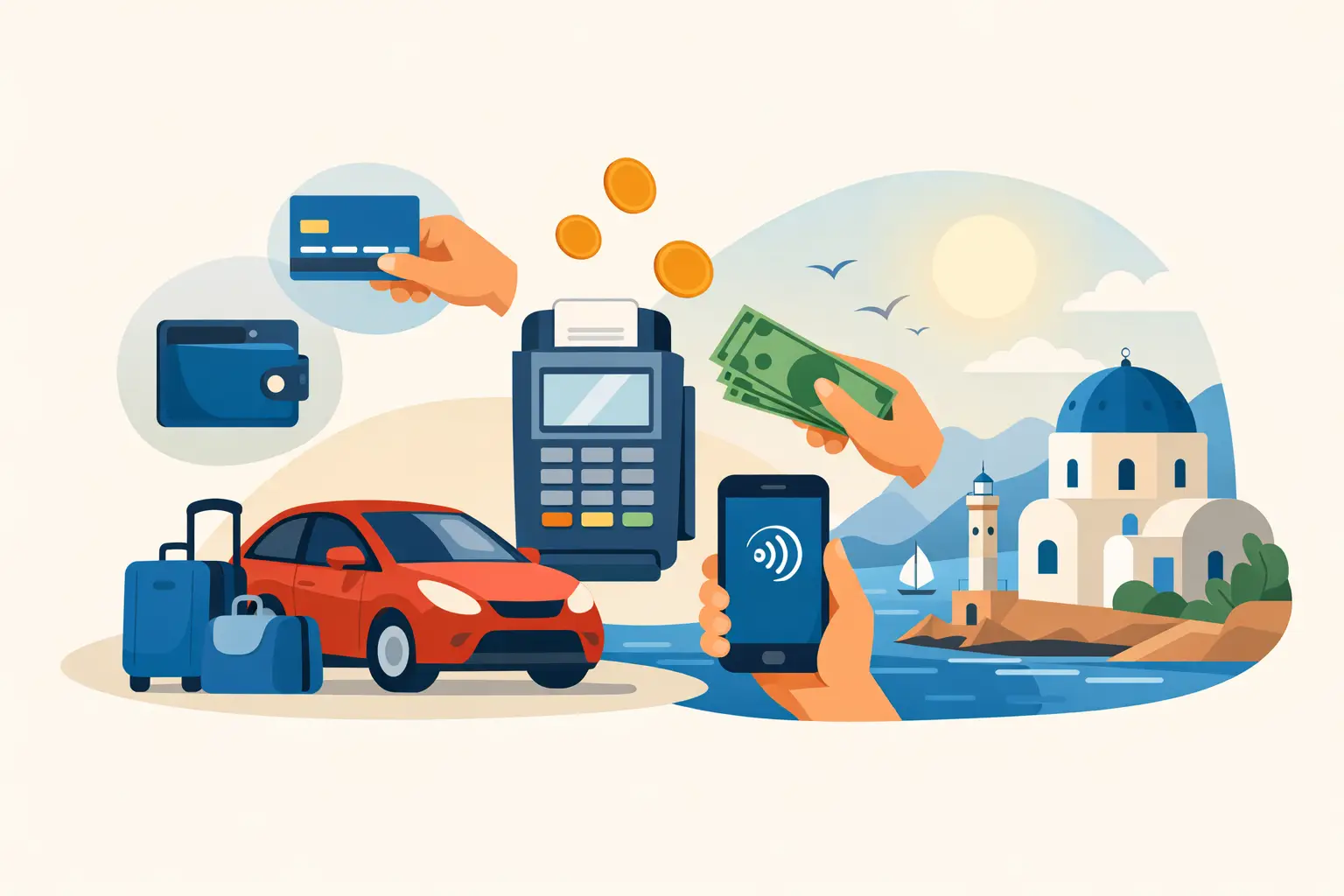
You have found the right car, chosen your dates and pictured the first drive from the airport towards your hotel. Then the payment screen raises a familiar holiday question: will the card in your wallet actually be accepted? Understanding car hire payment methods before you travel helps avoid delays at collection, unexpected deposits and the feeling that the price has changed after you booked.
For many visitors to Crete, the best rental payment process is not simply about whether a Visa or Mastercard logo is accepted. It is about knowing what you will pay, when you will pay it, whether a credit card is necessary and whether insurance excess or a security hold could affect your available funds.
Car hire payment methods: what to check first
Start with the total rental price, rather than the payment method alone. A low headline rate can look appealing until compulsory insurance, local taxes, mileage charges or an excess-reduction product appear later in the booking process. A clear quote should make it easy to see what is included before you confirm.
At ORION Rent A Car, the focus is on straightforward holiday motoring: VAT inclusive prices, free kilometres and comprehensive insurance with no excess, including theft and fire cover, tyres, glass and mirrors. This matters because the payment arrangement and the insurance arrangement are closely connected. Where there is no excess to secure, there is less reason for a large card hold to dominate your travel budget.
Before booking with any provider, check these practical points in the terms and booking summary:
- the amount due at booking and the amount due at collection
- whether a refundable deposit or card pre-authorisation is required
- whether the named driver must use their own card
- the currencies accepted and whether your bank may apply conversion charges
- what insurance is included, particularly the excess
- the cancellation and amendment arrangements if your travel plans change
A few minutes spent on these details can save a long conversation at the hire desk.
Credit cards are common, but not always essential
Traditional car hire companies often insist on a credit card in the lead driver’s name. They may use it to place a pre-authorisation against a large insurance excess. This is not a charge in the usual sense, but it can reduce the available balance on your card until the hold is released. Depending on your card issuer and the rental company, that release may take several days after the vehicle is returned.
This approach can be inconvenient for families managing holiday spending, travellers who prefer debit cards or anyone who does not keep a high credit limit available. It can also lead to confusion when a booking says it is paid but a significant amount is still held at collection.
A local rental company may offer a simpler approach, especially where comprehensive cover is already included and clearly stated. ORION does not require a credit card, giving guests more freedom to pay in the way that suits them. That does not mean you should assume every payment type is accepted for every booking. Always select your preferred method during booking and read the confirmation carefully, particularly if another person is paying for the reservation.
Debit cards: practical for holiday budgets
Debit cards are popular because they draw directly from your bank account and make it easier to keep track of holiday spending. They can be a sensible choice when the rental price is transparent and there is no substantial excess deposit to ring-fence.
The trade-off is that a debit card has less flexibility if a company places a large security hold. If funds are temporarily unavailable, you may have less available for accommodation, meals, excursions and fuel. For this reason, travellers using a debit card should look beyond the daily rental price and ask one direct question: is any deposit or pre-authorisation required, and how much is it?
It is also worth telling your bank that you are travelling to Greece if your banking app or provider recommends it. Modern fraud checks are useful, but a declined card just after landing at Heraklion or Chania is an unnecessary start to a holiday.
Digital wallets and online payment options
Apple Pay, Google Pay, PayPal and Revolut have made it much easier to pay without carrying several physical cards. They can be especially useful when booking from your mobile phone, as the card details do not need to be typed repeatedly into a form.
Digital wallets offer convenience, but they do not remove the need to understand the rental terms. A wallet payment may be accepted for the booking, while the supplier may still have rules about the named driver, identification or payment at handover. If you plan to use a virtual or disposable card number, check that it will remain valid for any later payment, amendment or refund.
Revolut and similar services can also help travellers manage spending in euros. However, exchange rates and fees can vary according to your plan, the day of the week and your allowance. Check the rate in your app before confirming payment, rather than assuming every conversion is free.
Paying in pounds or euros
Most visitors from the UK naturally think in pounds, while car hire in Crete is generally priced and processed in euros. If your bank or card terminal offers to convert the transaction into pounds, this is known as dynamic currency conversion.
It can look helpful because you see a familiar amount immediately, but the exchange rate may be less favourable than the rate offered by your card issuer. In many cases, paying in euros and allowing your bank or card provider to convert the amount gives better value. It depends on your card, so check its overseas transaction fees before you leave home.
The key is consistency. Compare the final price in euros, ensure VAT and insurance are already included where promised, then decide which payment method gives you the clearest conversion and the fewest extra charges.
Booking payment versus payment at collection
Car hire payment methods often fall into two stages. The first is the booking payment, which reserves the vehicle for your dates. The second is payment at collection or delivery, when you receive the keys and complete the rental agreement.
Some travellers prefer to pay ahead so that one major holiday cost is settled before departure. Others would rather pay closer to collection, particularly if flights or accommodation are still being finalised. Neither option is automatically better. Paying early can help with budgeting, while paying later may offer more flexibility if your plans are uncertain.
What matters is that the booking confirmation states the position plainly. Look for the total amount, any balance remaining, the accepted payment methods and the cancellation terms. If a price is described as all-inclusive, you should not arrive to find mandatory extras that were not visible when you booked.
Do not confuse a deposit with an insurance excess
These terms are often used together, but they mean different things. A deposit is an amount held or taken to cover potential costs, such as fuel, late return or damage. An insurance excess is the amount you may be liable for if the vehicle is damaged or stolen, even when insurance is in place.
A company may ask for a deposit, have an excess, have both, or have neither in the usual large-card-hold sense. This is why the words “fully insured” are not enough on their own. Ask whether collision damage cover has an excess, whether theft cover has an excess and whether vulnerable items such as tyres, glass and mirrors are included.
For driving on Crete, that clarity is valuable. Village lanes, mountain routes and busy resort parking areas are part of the adventure, but they are not the moment to discover that an apparently small rental price came with a sizeable financial liability.
A simple payment checklist before you fly
Keep your booking confirmation accessible offline on your mobile phone, along with your driving licence and any required identification. Make sure the name on the reservation matches the main driver, and bring the payment method you selected when booking. If you are using a digital wallet, take a physical backup card as well, particularly for travel days when battery or mobile signal may be limited.
Finally, leave enough available balance for fuel and ordinary holiday spending, even if your rental is paid in advance. A transparent rental should let you plan for those costs without guessing at hidden fees or a surprise excess hold.
The best payment method is the one you understand before you arrive: a clear price, a payment option that suits your budget and rental terms that let you collect your car and start enjoying Crete without unnecessary paperwork.
 Complete Insurance
 Free km (mileage)
 VAT – Inclusive price
Leave a Reply