
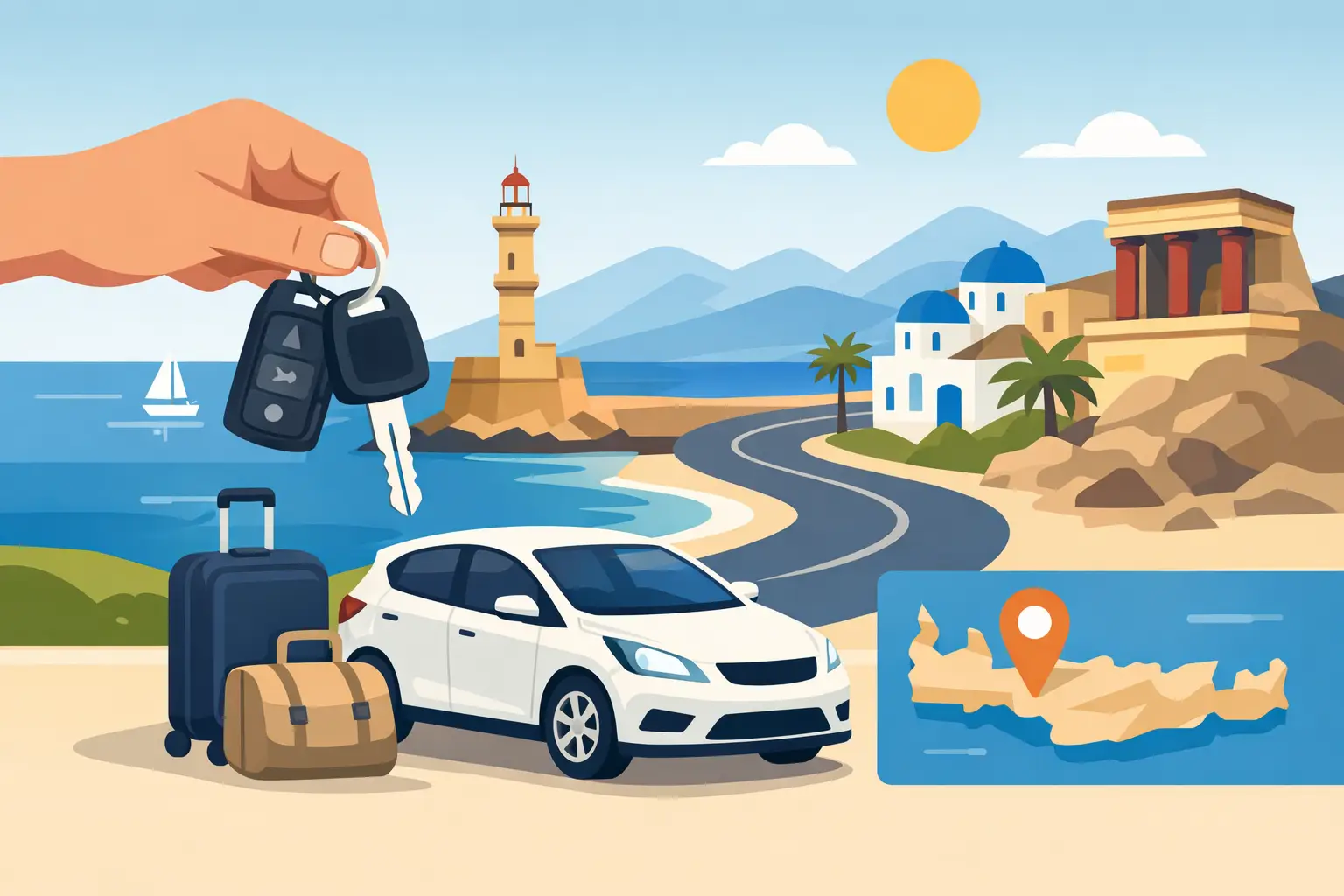
Landing at Heraklion with a week of holiday ahead is exciting, but the rental desk can quickly become the least relaxing part of the trip. Car hire for first time Crete visitors should feel straightforward: choose a car that suits your plans, know what you are paying for, collect it without a long wait, and set off with confidence.
Crete is a large island, with lively coastal resorts, traditional villages, mountain roads and beaches that public transport does not always reach easily. A hire car gives you the freedom to have breakfast in Koutouloufari, swim at a quiet cove, stop for lunch in a village taverna and return when it suits your family. The key is booking with clear expectations rather than simply choosing the lowest headline price.
Why a car makes sense on a first Crete holiday
If you are staying around Hersonissos, Stalis, Malia or Koutouloufari, you can certainly walk to restaurants, shops and the beach. But Crete rewards travellers who can go beyond the resort. The Palace of Knossos, Agios Nikolaos, Lasithi Plateau, Archanes and many south-coast beaches are far easier to enjoy with your own transport.
A car is particularly useful for families working around naps, couples who prefer quieter beaches, and visitors who want to explore at their own pace. It can also make practical tasks simpler, from supermarket trips to reaching an early boat excursion. On the other hand, if you plan to stay in one resort for three or four days and take organised trips, hiring a car for selected days may be better value than keeping one for the whole stay.
Car hire for first-time Crete visitors: choose the right size
The best car is not always the biggest one. Cretan roads vary from modern main routes to narrow village lanes with tight bends and limited parking. For two people travelling light, a compact car is usually easy to drive, economical and far less stressful in busy resort streets.
For a family with children, suitcases, beach equipment and a pushchair, allow enough boot space from the beginning. A small car can look economical online, then feel cramped before you have left the airport. If there are four adults with full luggage, consider a larger hatchback, estate or people carrier rather than assuming everyone will fit comfortably.
Automatic cars are a sensible choice if you do not regularly drive a manual or do not want to think about gears on hills and unfamiliar roads. They tend to be in higher demand, so book early. The same applies to child seats, which should be requested during booking rather than expected at collection.
Think about where you will actually drive
A standard two-wheel-drive car is suitable for the vast majority of holiday routes. It is ideal for north-coast towns, villages, archaeological sites and well-used routes into the interior. Do not book a vehicle based only on a dramatic photograph of an off-road track. Some unsealed roads are unsuitable under rental conditions and can invalidate cover if damage occurs.
If you are hoping to visit remote beaches, ask your rental provider about the planned route before you go. A local team can often suggest a safer access road, an alternative beach or the best time to travel. Good advice is more useful than taking a risk with a hire car on a road you do not know.
Look beyond the daily rate
The cheapest quote can become expensive when insurance, mileage, airport charges, extra drivers or local taxes are added later. Before you confirm a booking, check exactly what is included and what remains your responsibility.
For a relaxed holiday, look for comprehensive insurance with no excess for collision damage, theft and fire. Cover for tyres, glass and mirrors matters too, as these are often excluded or sold separately. Free kilometres and VAT-inclusive pricing remove two other common surprises. If a price seems unusually low, check whether it relies on a large excess, a deposit blocked on your card or insurance pressure at the collection desk.
A clear all-inclusive price lets you budget properly before travelling. At ORION Rent A Car, this means no excess, free kilometres, VAT included and no hidden costs, so customers know the rental cost before they arrive.
Do you need a credit card?
Not every traveller uses a credit card, and not every rental should demand one. Some companies require one for a security deposit even when the booking was paid for another way. Others accept debit cards or modern payment methods, but their conditions may differ.
Read this point before booking, especially if one person is making the reservation while another plans to drive. Confirm the main driver’s licence requirements, payment options and deposit policy in writing through the booking terms. A provider that clearly states no credit card required can remove an unnecessary airport problem for many visitors.
Airport collection or delivery to your accommodation?
Heraklion Airport is the most convenient arrival point for much of central and eastern Crete. Collecting there means you can begin your holiday immediately, avoid arranging a transfer and use the car from day one. It is a strong option for late arrivals, families with luggage or travellers staying outside the main resort centres.
Delivery to your hotel or villa can be equally convenient if you prefer to settle in first. This works well for visitors staying in Hersonissos or nearby villages who want a day by the pool before heading out. Chania Airport handovers are useful for those exploring western Crete, although the drive to the Hersonissos area is considerably longer.
Whichever option you choose, provide your flight details and accommodation information accurately. Flights can be delayed, luggage can take time, and a professional local rental company should have a clear plan for handover changes. Ask where you will meet, what documents to bring and how to contact the team outside normal hours.
Driving in Crete without unnecessary nerves
Driving is on the right in Greece. Take the first few kilometres slowly, particularly after leaving the airport, and allow time to become comfortable with the car. Use satnav as a guide, but pay attention to road signs and conditions in front of you. A route that looks simple on a map may include steep stretches, hairpin bends or a very narrow village centre.
On national roads, local drivers may travel faster than you expect. Keep right where possible, do not feel pressured to exceed your comfort level, and use suitable places to let faster traffic pass safely. Avoid sudden braking or stopping on bends. In towns and resorts, watch for scooters, pedestrians and cars pulling out of parking spaces.
Parking is usually easier outside the busiest centre streets. In popular places such as Agios Nikolaos, allow time to find a legal space and be prepared to walk a few minutes. Never leave valuables visible in the car, even for a short stop at the beach.
Plan mountain and south-coast days properly
A mountain journey often takes longer than the distance suggests. Build in time for photo stops, slower traffic and a relaxed lunch. Keep water in the car, make sure you have enough fuel before heading into less populated areas, and avoid starting a demanding route late in the afternoon.
For a south-coast day trip, decide whether you want a destination with easy road access or are happy with a more winding drive. Some of the island’s most memorable places are reached by slower roads, which is part of their charm, but they are not ideal when everyone is tired, hungry or due back for an evening reservation.
A few checks before you drive away
Take a moment at handover to understand the vehicle. Adjust the mirrors and seat, locate the lights and windscreen controls, and ask how to contact assistance if needed. Check that the fuel level and any existing marks are recorded correctly. A reputable company will not rush you through these questions.
Carry your driving licence, rental paperwork and a form of identification as required. If more than one person will drive, make sure each driver is listed on the agreement. It is much easier to arrange this in advance than to discover a restriction after a long day out.
Most importantly, choose a company that is available when plans change. Twenty-four-hour assistance offers reassurance if you have a flat tyre, a warning light or simply need practical advice on the road. You may never need it, but knowing help is there makes independent travel feel much lighter.
Your first drive in Crete does not need to be an expedition. Start with a simple route, perhaps a coastal lunch or a nearby village, learn the rhythm of the roads, and leave the longer adventures for the next day. With a properly sized car, transparent cover and a helpful local team behind you, the island soon feels wonderfully open.
 Complete Insurance
 Free km (mileage)
 VAT – Inclusive price
Leave a Reply