
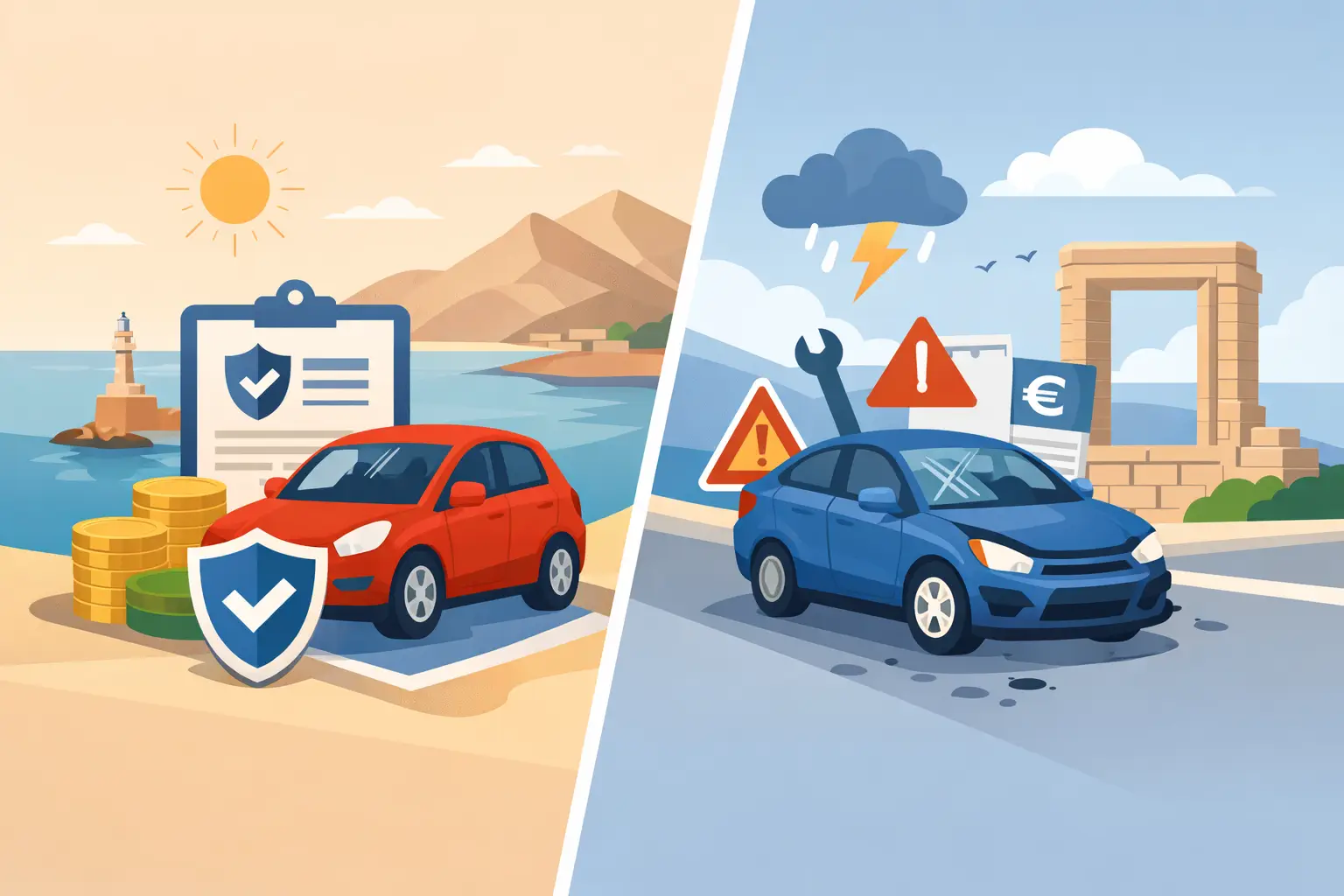
You usually spot the difference between basic cover and full cover at the least convenient moment – after a long flight, at the rental desk, with luggage piled up and a queue behind you. That is why understanding full insurance vs basic cover car hire Crete before you travel matters. On paper, basic cover can look cheaper. In practice, the gap often shows up later in excess charges, excluded damage, deposit requirements and awkward arguments about what is and is not covered.
Full insurance vs basic cover car hire Crete – what changes?
The short answer is peace of mind, but it helps to be specific. Basic cover usually means the legal minimum or a limited collision damage waiver with an excess. That excess can be high, and it often applies even if you thought you had taken out a decent level of protection. Full insurance, when it is genuinely comprehensive, is designed to reduce that exposure as much as possible.
For holidaymakers in Crete, this matters more than many first-time visitors expect. Roads vary from modern main routes to narrow village lanes. Parking near beaches, tavernas and busy resorts can be tight. Windscreen chips, tyre damage and mirror knocks are not everyday disasters, but they are common enough that you should understand the risk before you collect the keys.
A very cheap daily rate can stop looking cheap if the insurance leaves you carrying a large excess and paying separately for common types of damage.
What basic cover usually includes
Basic cover is often the entry-level package included in the headline price. It may cover major damage to the vehicle, but only subject to an excess. In simple terms, that means you still pay the first part of any claim, and that amount can run into hundreds or even thousands of euros.
It is also common for basic cover to exclude parts of the car that are most vulnerable on holiday use. Tyres, glass and mirrors are frequent examples. Underside and roof damage may also be excluded. Theft protection may be limited, and fire cover may not be as broad as people assume.
This is where many travellers feel caught out. They compare daily rates online, choose the lowest number, and only later realise that the lower price depends on them accepting more financial risk.
What full insurance should mean in practice
Full insurance is only worth paying for if it is clearly defined. The phrase gets used loosely in car hire, and not every so-called full package is actually full. The important questions are practical ones. Is there an excess? Is theft covered without excess? Are tyres, glass and mirrors included? Is there a large deposit blocked on your card? Do you need a credit card at all?
A proper comprehensive package should remove most of the stress points that spoil the start of a holiday. That means no hidden extras at collection, no surprise excess hanging over the rental, and no confusion about everyday damage risks.
For many travellers, especially families and couples arriving in Crete for a week or two, that clarity is worth more than saving a small amount per day on the booking screen.
The real cost difference is not always the headline price
This is where comparison gets more honest. Basic cover may appear cheaper when you first search, but the final cost can change after add-ons, deposit conditions and excess reduction products are offered at pick-up. Some travellers accept these upgrades under pressure because they do not want to spend the holiday worrying.
Others rely on third-party excess policies arranged separately. That can work, but it is not always straightforward. If something happens, you may still need to pay the rental company first and then claim the money back afterwards. That creates paperwork, delays and uncertainty at exactly the moment you want a simple solution.
With transparent all-inclusive pricing, you know from the start what you are paying for. That is one reason many visitors prefer a local company that states the insurance terms clearly rather than drawing them out later in the process.
Why Crete makes insurance detail more important
Crete is a brilliant island to explore by car because so many of its best places are easier with your own transport. That freedom comes with some normal local driving conditions that are worth being realistic about.
In resort areas such as Hersonissos, Stalis and Malia, parking can be busy in peak season. In older villages, streets can be narrower than visitors are used to at home. On mountain routes, road edges may be rougher, and on beach trips, loose stones can increase the risk of tyre or windscreen issues.
None of this means driving in Crete is difficult for most visitors. It simply means insurance wording matters. A package that excludes tyres, glass and mirrors may leave you exposed to exactly the type of minor damage that tends to happen on a perfectly ordinary holiday.
Full insurance vs basic cover car hire Crete for different travellers
If you are staying in one resort and only planning short drives, basic cover may feel like a risk worth taking. Some confident travellers do make that choice, especially if they are experienced with rental terms and comfortable carrying a larger excess.
But for most holidaymakers, full cover is the more comfortable fit. Families tend to value speed and certainty. Couples on a short break usually do not want the trip starting with a debate over deposits and exclusions. Groups sharing driving responsibilities often prefer simple terms that everyone understands.
First-time visitors to Crete are rarely looking for insurance complexity. They want to collect the car, head to their hotel or villa, and start the holiday without second-guessing what happens if a mirror is clipped in a village lane.
Questions worth asking before you book
Rather than focusing only on the daily rate, look at the conditions around it. Ask whether there is any excess for collision damage, theft or fire. Check whether tyres, glass and mirrors are included. Find out if mileage is free, whether VAT is already included, and whether a credit card deposit is required.
These details tell you far more about value than a low starting price does.
At ORION Rent A Car, the approach is simple and direct because that is what travellers actually need. Pricing is built around comprehensive cover with no excess, theft and fire cover with no excess, cover for tyres, glass and mirrors, free kilometres, VAT-inclusive rates and no credit card required. That removes the usual friction points before they become holiday problems.
When basic cover can still make sense
There are cases where basic cover may suit a traveller. If your budget is extremely tight and you fully understand the excess, the exclusions and the deposit conditions, it may be a deliberate decision rather than a mistake. The key is that you should be choosing the risk knowingly.
It can also suit experienced renters who have separate cover arranged and are comfortable managing claims afterwards. Even then, it is wise to read the terms carefully, because the cheapest route is not always the least stressful one.
The trouble starts when basic cover is chosen because the headline rate looked attractive, without understanding how much exposure remains underneath it.
How to choose without overpaying
The best approach is not to buy every extra offered automatically. It is to compare complete terms, not teaser prices. Look for a rental that clearly states what is included and what is not. If the insurance wording feels vague, or if you cannot easily see the excess and exclusions, assume you do not yet have the full picture.
Good value in Crete usually means a fair total price, clear insurance, straightforward collection, and support if you need help on the road. That is especially true if you are flying into Heraklion or Chania and want the handover to be quick rather than filled with upselling.
A holiday car should give you freedom to see more of the island, from north coast resorts to quieter villages and beaches further afield. It should not leave you worrying about whether one scratched alloy or cracked mirror will turn into an expensive dispute.
The right cover is the one that lets you enjoy Crete with a clear head. If basic cover still feels worth the gamble after you have read every term, at least you are deciding with your eyes open. For most people, though, full cover is not about paying for extras. It is about paying once, knowing where you stand, and getting on with the holiday.
 Complete Insurance
 Free km (mileage)
 VAT – Inclusive price
Leave a Reply