
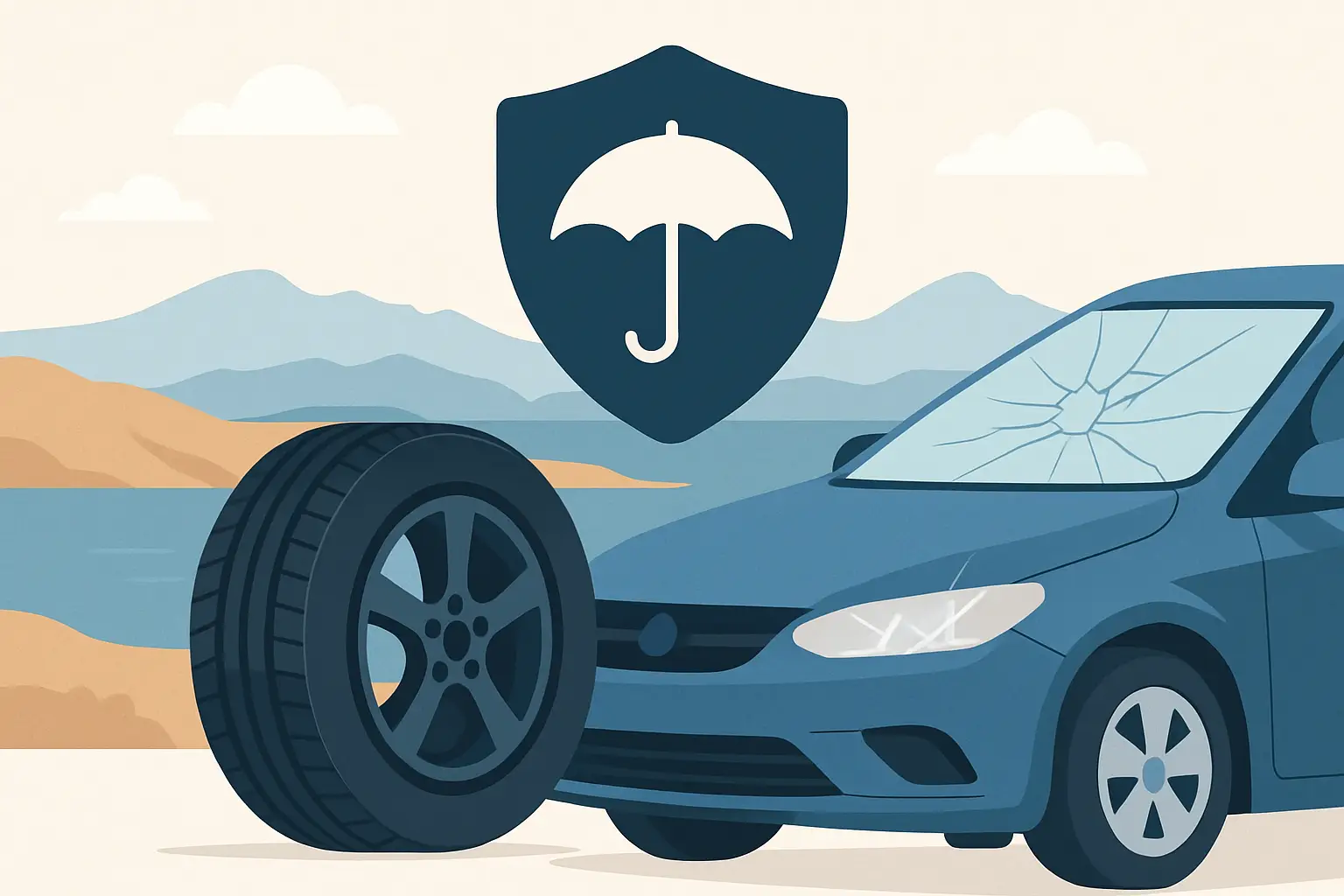
You have just turned off the main road to reach a quiet beach, and the track suddenly changes from tarmac to loose stone. It is the sort of moment that makes you grip the steering wheel a little tighter, not because it is difficult, but because you are thinking, “If I pick up a nail or chip the windscreen, what happens next?”
That is exactly why Crete car rental tyre and glass insurance comes up so often in bookings. Tyres and glass are the two most common, most irritating holiday claims. They can also be the two items that sit outside standard cover, which is where surprise charges and long deposit holds can spoil an otherwise perfect week.
What “tyre and glass” actually means on a hire car
When people ask for tyre and glass cover, they are usually talking about protection for the parts of the vehicle that are most exposed to everyday road hazards. In plain terms, this normally includes the windscreen and other windows, and the tyres. Many packages also mention mirrors because they are fragile in car parks and tight village streets.
The important detail is that “tyre and glass” is not a universal definition across all rental companies. One provider might include the windscreen but not side windows. Another might cover glass but exclude the cost of fitting. Some cover a puncture repair but not a tyre replacement. You cannot assume the wording is the same just because the phrase sounds familiar.
So the real question is not “do you have tyre and glass insurance?” but “what exactly is included, and is there an excess?”
Why Crete makes tyre and glass cover feel more relevant
Crete is easy to drive for most UK visitors. Roads along the north coast are straightforward, signage is generally clear, and distances are manageable. The risk is not that Crete is dangerous. The risk is that you will use the car properly – beaches, viewpoints, rural tavernas, mountain villages – and those lovely plans often involve the places where tyres and glass are most likely to be damaged.
Loose stones on access roads are the obvious one. Even if you drive slowly, a sharp stone can find a tyre edge, and gravel flicked up by another vehicle can chip a windscreen. Add summer heat and long drives and tyres are simply under more stress than they are on a short UK commute.
Then there is the practical reality of holiday driving. You will park in unfamiliar places. You will reverse where you would not reverse at home. You might squeeze past an oncoming car on a narrow lane. Mirrors and glass do not need a dramatic “accident” to be damaged.
The common misunderstanding: CDW does not always mean “everything”
Many travellers see “CDW” and assume they are fully protected. CDW (Collision Damage Waiver) generally relates to damage to the car bodywork, and even then it often comes with an excess. Tyres and glass are frequently listed as exclusions, alongside the underbody.
This is where frustration starts. A company can advertise “insurance included” and still charge you for a puncture or a cracked windscreen, because those items were never included in the first place. If there is also an excess, you can end up paying a large amount for a fairly small incident.
A good rule of thumb is: if a rental price looks unusually low, check the exclusions and the excess before you get attached to it.
Excess, deposits, and why small damage can turn into a big bill
Even when tyre and glass cover exists, it may not be “no excess”. Excess is the amount you pay first on any claim. On some rentals the excess can be several hundred euros, sometimes more than a replacement tyre and not far off a windscreen.
Deposits are the second part of the picture. If a company holds a large deposit on a credit card, and you have an incident, it is common for them to keep some or all of it until the repair cost is confirmed. That can create holiday stress, especially if you are travelling without a credit card or you simply do not want a large hold on your limit.
For many UK travellers, peace of mind means two things together: tyre and glass included, and no excess. Without both, you can still end up paying at the desk or after the return.
What to look for in Crete car rental tyre and glass insurance
You do not need legal language to protect yourself. You need a few clear answers before you book.
First, confirm whether tyres are covered for punctures and for replacement. A puncture repair is one thing. A sidewall cut is another, and that is usually replacement.
Second, confirm which glass is covered. Windscreen is the big one, but side windows and rear glass matter too, especially with luggage in the boot on a hot day.
Third, check mirrors. Mirrors are not always included under “glass”, yet they are one of the most frequently clipped parts of the car.
Finally, ask the “holiday reality” questions. If you get a puncture outside office hours, who helps you? Do you call a local number? Is there 24 hour assistance? The cover is only as useful as the process for using it.
The trade-off: buying separate excess cover vs choosing inclusive pricing
Some travellers try to solve the excess problem by buying a third-party excess reimbursement policy. It can work, and sometimes it is cheap. The catch is that it does not stop the rental company charging you in the first place. It usually reimburses you later, after forms, invoices, and waiting.
On a short break, that admin can feel like the opposite of what you wanted when you booked a car for convenience.
The alternative is to choose a rental that includes the protection upfront with no excess and no hidden extras. That tends to cost more on the headline daily rate, but it is often the more predictable option. “It depends” comes down to your tolerance for risk and paperwork. If you are happy to float a charge and claim it back later, reimbursement cover can be fine. If you want a clean, fixed cost and a quicker handover, inclusive pricing usually wins.
How to reduce the chances of tyre or glass damage in Crete
Insurance is your backstop. Driving choices are the first line of defence, and they are simple.
Take unmade roads slowly and avoid the temptation to “just get it over with”. Most punctures happen when a tyre hits a sharp edge at speed. The same goes for gravel tracks to beaches – keep a gentle pace and leave more space to the car ahead to reduce stone chips.
If you are heading into the mountains, plan your fuel and timing so you are not rushing on narrow roads as the light drops. A calm drive reduces clipped mirrors and kerb damage, and it is a nicer way to see the island.
And when you park, choose the easiest space, not the closest one. A five-minute walk is better than squeezing into a tight spot that invites a mirror knock.
If something happens: what to do so it stays hassle-free
Most stress comes from uncertainty. If you pick up a puncture or notice a chip, deal with it promptly.
Photograph the issue clearly. If it is a tyre, include the tread and sidewall in the photo. If it is glass, take one close-up and one wider shot showing where it is on the car. Then call the assistance number provided with the rental. Even if you think you can “sort it later”, reporting it early usually makes the process smoother.
If the car feels unsafe, do not drive it. A slow leak can become a shredded tyre quickly in the heat, and that can create extra damage. If you are covered, using the support you are paying for is the sensible choice, not an inconvenience.
The simple benchmark for a fair rental in Crete
If you want a quick way to judge whether a deal is traveller-friendly, look for three phrases and make sure they are real, not vague.
You want “no excess” on the main insurance, you want tyres and glass included (ideally also mirrors), and you want “no hidden costs” in the quote, meaning VAT is included and mileage is not restricted. Add 24 hour assistance and the experience becomes what it should be: a straightforward hire car that supports your holiday rather than complicating it.
This is the thinking behind local, all-inclusive operators such as ORION Rent A Car, which builds tyre, glass, and mirror cover into transparent pricing with no excess, alongside free kilometres and clear, VAT-inclusive quotes. For travellers who are tired of upsells at the desk, that clarity is often the whole point.
When tyre and glass cover might be less critical
There are scenarios where you might decide you can live without it. If you are staying in one resort, using the car for short trips on main roads, and you are comfortable with an excess and a deposit, you may feel the risk is low enough.
But be honest with your itinerary. If your plan includes Balos-style access roads, rural south-coast beaches, or lots of village exploring, you are increasing exposure. The cost difference between “basic” and “properly covered” often looks small compared to the cost of even one windscreen replacement.
The other time it matters is when you want simplicity. Even if you never claim, knowing that tyres and glass are covered with no excess changes how you feel on day one. You stop listening for every pebble. You enjoy the drive.
What you choose is personal, but the best holidays in Crete tend to follow a pattern: you book the car that makes the money side boring, so the island can be the interesting part.
 Complete Insurance
 Free km (mileage)
 VAT – Inclusive price
Leave a Reply