
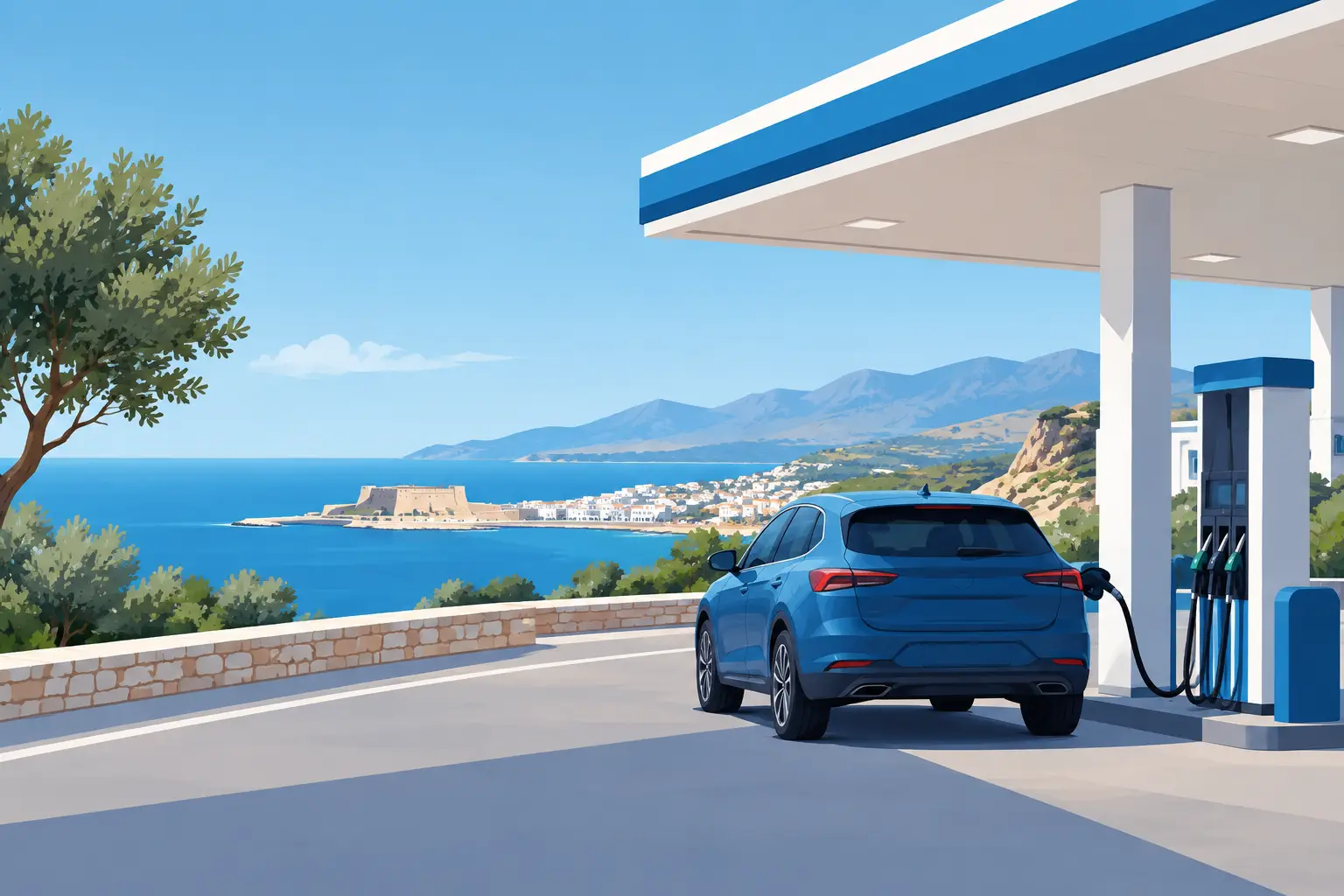
A drive in Crete can take you from the busy coast to a quiet mountain village in an hour, but fuel stops are not always as predictable as they are at home. Knowing how to use Crete petrol stations before setting off helps you avoid the two holiday worries nobody needs: choosing the wrong fuel and finding yourself low on petrol far from the nearest town.
The good news is that filling up is usually straightforward. Petrol stations are common around Heraklion, Hersonissos, Malia, Agios Nikolaos, Rethymno and Chania, and most are attended during normal daytime hours. A few practical habits will keep every stop quick, clear and stress-free.
How to use Crete petrol stations
At many Crete petrol stations, an attendant comes to the pump, asks what fuel you need, fills the car and takes payment. You normally do not need to operate the pump yourself. This is particularly useful if you are unfamiliar with the fuel names or using a hire car for the first time.
Before the attendant starts, tell them the fuel type and either the amount you would like to spend or that you would like the tank filled. A simple request such as “unleaded, full please” is usually understood. If you prefer to control holiday spending, you can ask for a set value instead, for example €30 or €50.
It is worth checking the pump display before and after filling. This is not about expecting a problem – it is simply a sensible travel habit. Confirm the fuel grade, litres and total price before paying, then take your receipt if you need it for expenses or to keep track of your journey.
Choose the correct fuel every time
The most common petrol choice is unleaded 95, often marked as 95 or Unleaded. Higher-octane unleaded, such as 98 or 100, may also be available but is not necessary unless your vehicle specifically requires it. Diesel is clearly labelled, but never rely on the colour of a nozzle alone.
Check the fuel label inside the filler flap or near the fuel cap before your first fill-up. Your rental agreement or vehicle handover information should also state the correct fuel. If there is any doubt, stop and ask the attendant to confirm before they begin. Putting petrol into a diesel vehicle, or diesel into a petrol vehicle, creates an avoidable delay and can lead to costly repairs.
Most modern hire cars in Crete use unleaded petrol, but vehicle type matters. Larger people carriers, SUVs and some estate cars may be diesel. Do not assume that the vehicle next to you takes the same fuel as yours.
Payment, receipts and small practical details
Cards are widely accepted at larger stations, especially in towns, along main roads and near airports. Contactless payment is common, although cash remains useful at smaller independent stations and in more remote parts of the island. Keep some euros with you rather than depending entirely on one card or a mobile wallet.
Ask for a receipt before leaving, particularly if you have paid cash. If you are paying by card, check that the amount shown on the terminal matches the pump total. The price of fuel is displayed per litre, as you would expect, and the final total appears on the pump screen.
A few stations may have self-service pumps outside main staffed hours. Instructions can vary and card authorisation systems are not always as familiar as those in the UK. If a machine is unclear, do not keep trying different buttons or cards while the tank is nearly empty. Fill up earlier in the day when possible, or choose a larger, staffed station on a main route.
When and where to fill up in Crete
On the north coast, you will find plenty of petrol stations around the main urban areas and along the national road. It is easy to refuel before visiting places such as Knossos, Agios Nikolaos or Rethymno. However, once you turn inland, distances feel longer than they look on a map. Mountain roads are slower, villages are smaller and stations can be limited.
The same applies to the south coast. Routes towards Matala, Lentas, Sougia, Paleochora, Plakias and more secluded beaches are beautiful, but they are not places to begin looking for fuel with the warning light already on. Fill up in a larger town before crossing the island or heading into the hills.
A useful rule is to refill when the gauge reaches around a quarter of a tank if your plans include remote roads, a late return or a long day of sightseeing. It gives you freedom to take an unplanned turn towards a village taverna, viewpoint or beach without calculating every kilometre.
Prices can vary slightly between stations. Fuel on main tourist routes, motorway-style roads or remote areas may cost a little more than in larger towns. It is usually not worth driving out of your way to save a small amount, particularly when holiday time is limited. Choose a well-lit, established station where you feel comfortable and focus on convenience.
Driving habits that affect fuel use
Crete is not a place where the shortest route always uses the least fuel. A journey through the mountains may be short in kilometres but involve steep climbs, tight bends and frequent braking. Air conditioning, a full car and luggage also increase consumption, especially in summer.
Plan your fuel around the kind of driving you will do, not just the distance shown on your sat-nav. A family day out with mountain villages, beach stops and a return after sunset can use more fuel than a straightforward airport transfer. If you have a small car, this is normal – it does not mean there is a fault.
Try not to let the tank run very low. Apart from the inconvenience, a near-empty tank is less reassuring on unfamiliar roads where mobile signal can be patchy. A full or comfortably topped-up tank also makes the final part of your holiday calmer, especially if you are returning a car near Heraklion or Chania Airport.
Fuel and your rental return
Always check the fuel policy on your booking confirmation. Many travellers prefer a full-to-full arrangement: collect the vehicle full, refill close to the agreed return point and bring it back at the same level. It is transparent and means you pay only for the fuel you use.
If you need to refill before an airport handover, allow extra time. The final stretch can be busy in peak season, and it is much easier to stop at a station before reaching the airport area than to turn back after you have arrived. Keep the receipt until the vehicle has been returned, just in case there is a question about the fill level.
At ORION Rent A Car, we believe the practical details should be clear from the start, including the fuel type for your vehicle and the return arrangement. A quick question at handover is always better than uncertainty halfway through your trip.
Common mistakes to avoid
The most frequent mistake is assuming all fuel pumps are self-service. Wait a moment when you arrive, as an attendant may come over quickly. If they do not, look for instructions on the pump or ask inside before starting.
Another is filling up too late before a rural excursion. Petrol stations are not absent from the Cretan countryside, but they are not positioned for the convenience of every scenic route. Refuel while you still have choices.
Finally, do not be embarrassed to ask for help. Local station staff deal with visitors every day and are used to clarifying unleaded versus diesel, filling to a set amount and assisting with card payment. A brief conversation can prevent a long interruption to your holiday.
Treat fuel stops as part of a well-planned day rather than an emergency task. With the right fuel confirmed, some cash or a working card to hand and a sensible refill before the quieter roads, you can concentrate on the reason you hired a car in the first place: seeing more of Crete at your own pace.
 Complete Insurance
 Free km (mileage)
 VAT – Inclusive price

Leave a Reply